
Introduction
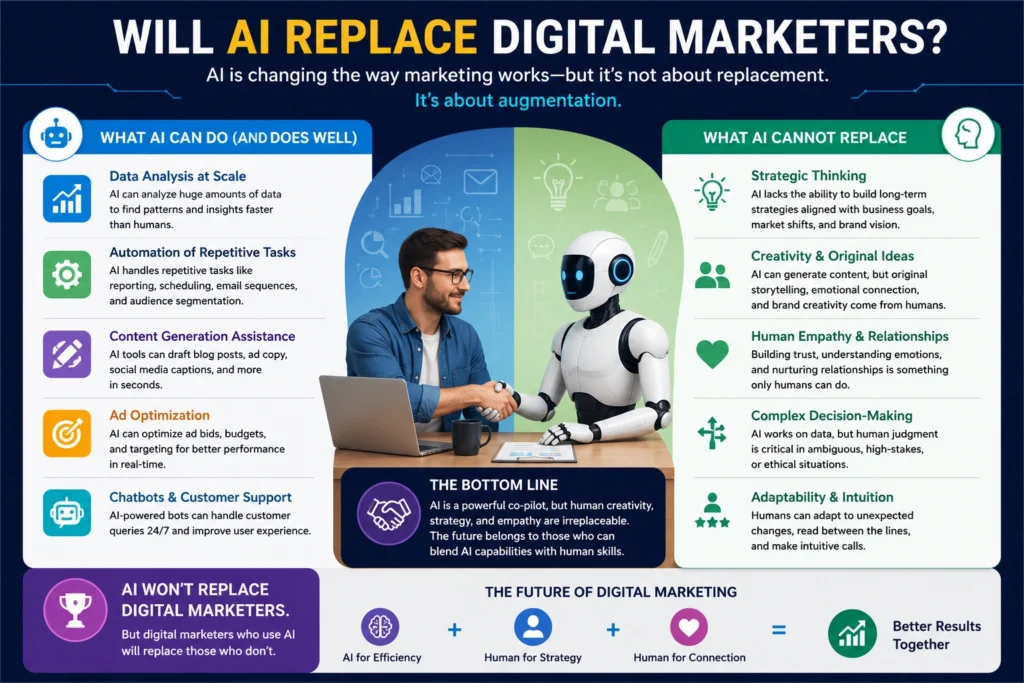
Artificial Intelligence (AI) is rapidly changing the digital marketing landscape by automating tasks, analyzing data, and improving customer targeting. Many people wonder whether AI will replace digital marketers completely. While AI is powerful, it mainly acts as a supportive tool. Digital marketing still needs human creativity, emotional intelligence, and strategic thinking, which AI cannot fully replicate.
1. Rise of AI in Digital Marketing
AI is now widely used in digital marketing for tasks like customer targeting, ad optimization, and content recommendations. It helps businesses analyze user behavior and improve marketing performance. However, despite automation, human marketers are still needed to design campaigns and interpret insights effectively.
2. Automation of Repetitive Tasks
AI can easily handle repetitive marketing tasks such as email scheduling, reporting, and social media posting. This saves time and increases efficiency. Marketers can then focus on strategy and creativity. AI improves productivity, but it does not replace decision-making roles in marketing.
3. Content Creation and AI Tools
AI tools can generate blogs, captions, and product descriptions quickly. However, AI-generated content often lacks emotional depth and originality. Human marketers are still essential for storytelling, brand voice, and creating meaningful connections with audiences.
4. Importance of Human Creativity
Marketing success depends heavily on creativity and innovation. Humans understand emotions, culture, and trends better than machines. AI can assist with ideas, but creative campaign development still requires human imagination and insight.
5. Strategic Thinking Cannot Be Automated
Digital marketing involves long-term planning, competitor analysis, and brand positioning. AI can provide data, but humans make strategic decisions. Marketers use experience and intuition to build effective campaigns that AI alone cannot design.
6. AI Improves Customer Experience
AI-powered chatbots and recommendation systems improve customer service and personalization. They provide instant responses and enhance user experience. Still, complex customer problems require human interaction and empathy.
7. Data Analysis and Insights
AI can process large datasets quickly and identify trends in customer behavior. This helps marketers make data-driven decisions. However, interpreting insights and applying them in campaigns still requires human judgment and experience.
8. Emotional Intelligence in Marketing
Marketing is deeply connected to human emotions. AI cannot truly understand feelings like trust, excitement, or loyalty. Human marketers use emotional intelligence to create impactful campaigns that connect with audiences on a personal level.
9. Evolving Skills for Marketers
Instead of replacing jobs, AI is changing the required skills. Digital marketers now need to learn AI tools, analytics, and automation platforms. Creativity, communication, and strategic thinking remain essential for career growth.
10. Ethical Challenges in AI Marketing
AI raises concerns about privacy, data usage, and transparency. Human oversight is important to ensure ethical marketing practices. Marketers play a key role in maintaining trust between businesses and customers.
11. Future of AI and Digital Marketing
The future of marketing will be a collaboration between humans and AI. AI will handle technical tasks, while humans focus on creativity and strategy. This partnership will make marketing more effective and innovative.
Courses in Data Science and AI (Skill Development Path)
To stay competitive in the AI-driven marketing world, professionals often upgrade their skills through training programs. Institutes like the Data Science Training Institute (DSTI) offer career-oriented courses in Data Science, Machine Learning, Python programming, Business Analytics, and Data Visualization.
These courses help marketers understand AI tools, data analysis, and automation techniques, which are becoming essential in modern digital marketing roles.
Conclusion
AI is transforming digital marketing but not replacing it. It can automate tasks, analyze data, and improve efficiency, but it cannot replace human creativity, emotional intelligence, and strategic thinking. The future belongs to digital marketers who learn AI tools and combine technology with human skills to build smarter and more impactful marketing strategies.