
Introduction: AI in Legal Tech
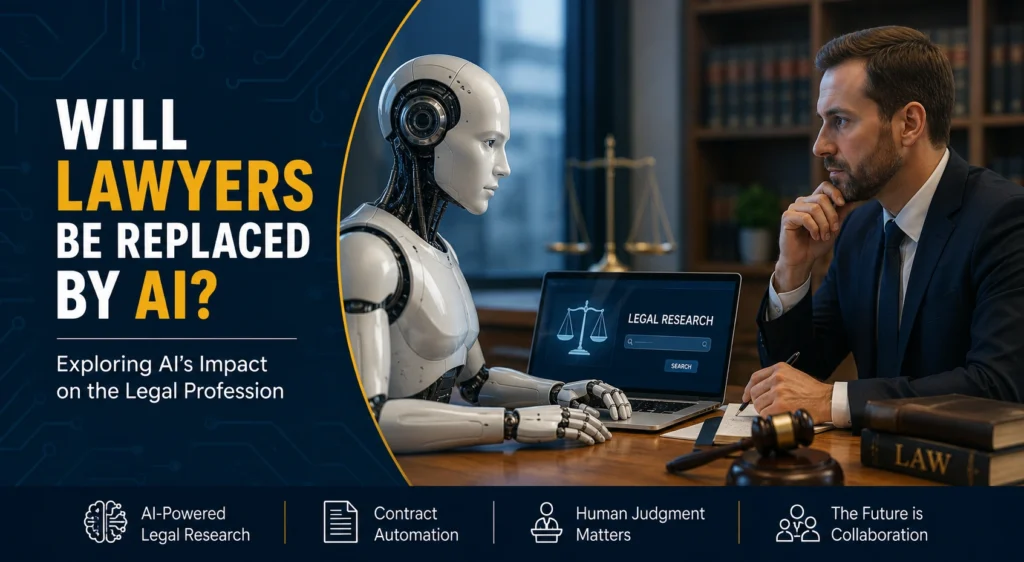
Artificial intelligence is rapidly reshaping the legal industry by automating research, drafting, and document review. This raises a key question: will lawyers be replaced by AI? While AI improves speed and efficiency, it cannot replace human judgment, ethics, and advocacy. The future is focused on collaboration, not full replacement.
1. AI is Transforming Legal Workflows
AI is automating repetitive legal tasks like document review, contract analysis, and case summarization. This boosts productivity and reduces workload for lawyers. However, critical legal decisions still require human reasoning, experience, and interpretation, which AI cannot fully replicate.
2. Faster Legal Research with AI
Legal research is now faster and more efficient with AI tools that scan large databases in seconds. Lawyers can quickly find relevant cases and statutes. Still, understanding context and building strong legal arguments remains a human skill.
3. Contract Drafting is Becoming Automated
AI can draft standard contracts and detect risky clauses instantly. This is useful for routine legal work in corporate firms. However, negotiation, customization, and legal strategy still require experienced human lawyers.
4. AI Lacks Legal Reasoning
Law involves interpretation, ethics, and intent—not just data processing. AI cannot fully understand complex legal reasoning or moral judgment. Therefore, human expertise remains essential in decision-making.
5. Courtroom Advocacy Needs Humans
Courtroom litigation requires persuasion, emotional intelligence, and quick thinking. Lawyers must respond to unexpected arguments in real time. AI systems cannot replace these abilities.
6. Ethics and Responsibility Stay Human
Legal professionals are responsible for confidentiality, ethics, and accountability. AI tools can assist but cannot take responsibility for legal outcomes. Human oversight is always required.
7. AI is Changing Entry-Level Legal Jobs
Many junior-level tasks, like document review, are now automated. This reduces repetitive work but also changes how young lawyers learn, pushing them toward higher-level analytical and strategic roles earlier.
8. AI Improves Access to Justice
AI-powered tools make basic legal information and documents more accessible and affordable. This helps individuals who cannot afford expensive legal services, improving access to justice.
9. Law Firms Are Adapting, Not Disappearing
Instead of replacing lawyers, AI is being integrated into law firms to improve efficiency. Firms that adopt AI gain a competitive advantage, while lawyers who adapt remain highly valuable.
10. New Career Opportunities in Legal-Tech
AI is creating new job roles such as legal technologists, compliance analysts, and data-driven legal consultants. These roles combine law with technology and expand career opportunities.
11. Role of Skill Development in the AI Era
To stay relevant, professionals need strong technical and analytical skills. Institutes like Data Science Training provide industry-focused courses such as Data Science, Machine Learning, Artificial Intelligence, Python for Data Science, Power BI, Data Analytics, Business Analytics,
SQL and Data Analysis Training in Delhi. These skills support careers across legal-tech, analytics, and AI-driven industries.
Conclusion: Replacement or Reinvention?
AI will not replace lawyers but will reshape their roles. Routine tasks will be automated, while human skills like reasoning, ethics, and advocacy remain essential. The future of law lies in collaboration, where AI supports lawyers to make the legal system faster, smarter, and more efficient.